

CTP Tech
InTheGarageMedia.com
Brushing black rust coating onto a truck firewall.
Conversion Therapy
Making Rust Go Bust On A 1964 C10 Firewall With KBS Coatings
BY RYAN MANSONIMAGES BY THE AUTHOR
A

nyone who has ever had a sheet metal panel media blasted and failed to immediately cover said panel with some sort of protective coating knows what the expected result can be: surface rust. It might take a week, might take a month, but Mother Nature knows no bounds and she certainly doesn’t care that you’d like to retain that bare-metal beauty in her natural element for as long as possible (or at least as long as it takes to make all the necessary sheet metal repairs!). That was the state we found ourselves after we had our ’64 C10 cab blasted and proceeded to begin the repairs that we’ve covered thus far. For the first few months, the sheet metal was bare and clean, making repairs a fairly straightforward task. But over time, moisture and humidity began to seep in and soon enough, instead of a rose-colored glasses view of our project, our cab began to take on a rosy-colored hue, and it didn’t fill us full of optimism!

Optimism did in fact prevail, however, after speaking with the guys at KBS Coatings and relaying our project’s current woes. Not wanting to have to reblast the entire cab, we called looking for a chemical solution that we could apply at home to solve our surface rust issue before we press on with the usual body and paint process. Turns out, KBS Coatings has a three-part process that cleans, converts, and seals rusty surfaces for good. Known collectively as the Stop Rust Kit, it consists of KBS Klean, KBS RustBlast, and KBS RustSeal. Available in quart form for smaller projects or gallon form for large ones, the Stop Rust Kit is the perfect method to solve surface rust and effectively kill it in its tracks.

While we covered the components of the KBS Stop Rust Kit in a previous story, what we didn’t cover are the methods of application and best practices to be followed for each step. The first step will be to wash the entire firewall area with KBS Klean, a concentrated, waterbased, biodegradable cleaner that will prep the surface to be nice and clean. Next, KBS RustBlast, a powerful rust remover, zinc phosphate pre-primer, and metal etch will be applied to the surface as well. RustBlast effectively dissolves rust, corrosion, metal oxides, and tarnish from most metal surfaces, leaving behind a prefect foundation for the next step, KBS RustSeal. Impervious to road salts and a variety of chemicals, RustSeal is a high-performance, single-part, ready-to-use, rust preventative ceramic-like coating that is resistant to scratch or chipping and will not crack or peel.

When it’s all said and done, we’ll be using the KBS Stop Rust three-part system to effectively protect the majority of our C10 cab’s sheet metal, while some sections, such as the firewall and dash, will then be finished in a more traditional paint and body manner with KBS filler primer, body filler, and topcoated with KBS Maxx. Inside the cab, RustSeal will provide the final finish before insulation and interior is installed, while underneath the cab, the process will be repeated followed by an application of KBS Coatings’ Rubberized Undercoating.

With 60-plus years of neglect and abuse, it’s apparent the need to address many areas of our C10’s cab to get it up to modern standards. And with rust being one of the biggest culprits of damage on many an old truck, we can rest assured that, once addressed with the proper techniques and products thanks to KBS Coatings, we can kill that cancer, once and for all.

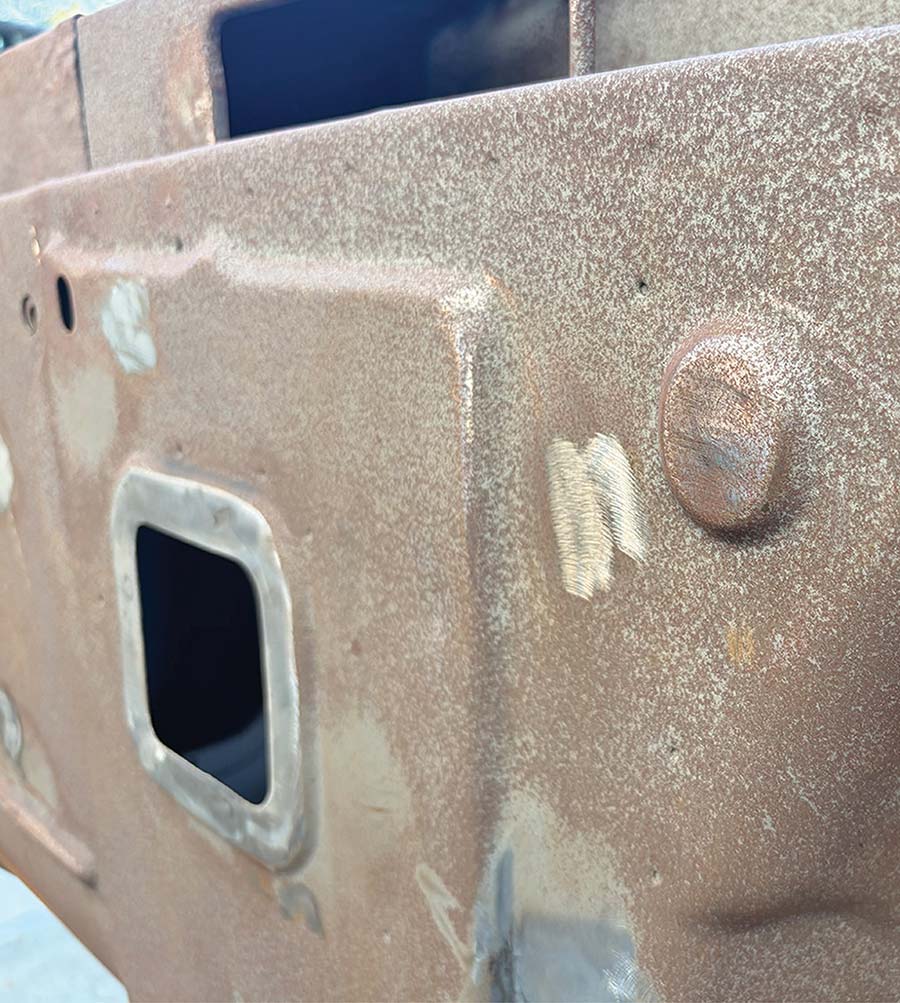
Bare metal truck firewall with surface rust.
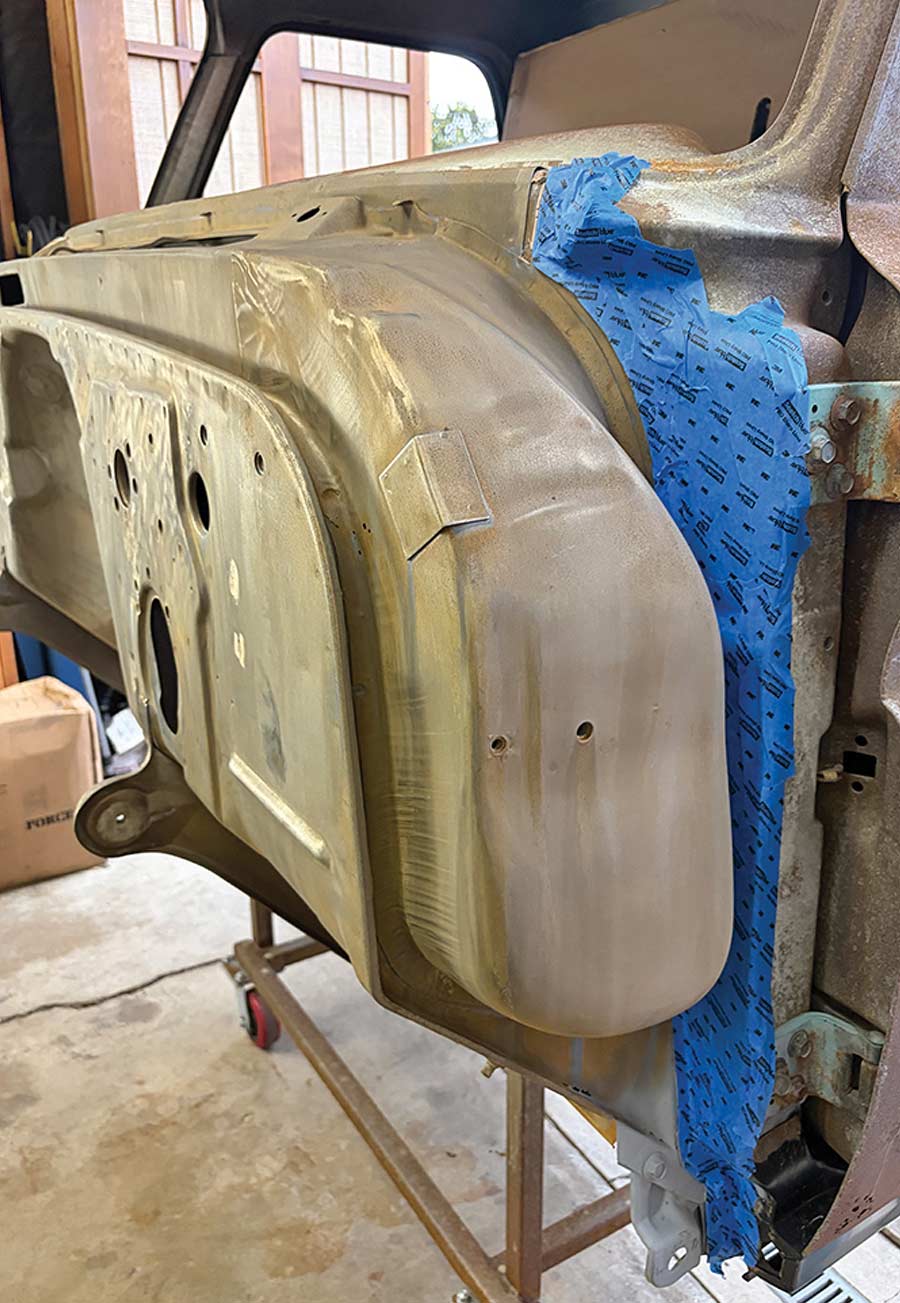
1. Surface rust is a real nightmare when a bare-metal project sits unprotected. Before we can even think about shooting a finish on this surface, we need to address the issue at hand.
Sanding a small area of a metal panel.
2. A freshly blasted surface should be knocked down with a sander regardless of the presence of surface rust.
Truck firewall with some surface rust removed.
3. After a few minutes of orbital sanding, a fair amount of surface rust has already been removed and the surface of the firewall is one step closer to being prepped for a final finish.
Full view of the C10 cab firewall on a stand.
4. With the heaviest of surface rust removed, we have one more hole to fill, that of the heater box.
Magnets holding a metal patch over the heater box hole.
5. To do so, a section of similarly sized sheet metal is rough cut to cover the hole and held in place with a pair of magnets.
Scribing the patch shape from inside the cab.
Metal patch with scribed lines ready for trimming.
6-7. From the inside of the cab, we can carefully scribe the shape of the hole onto the sheet metal patch.
Magnets holding the trimmed patch in place from inside.
Trimmed metal patch held in place from the outside.
8-9. The same magnets are then mounted on the inside of the cab to hold the trimmed patch in place.
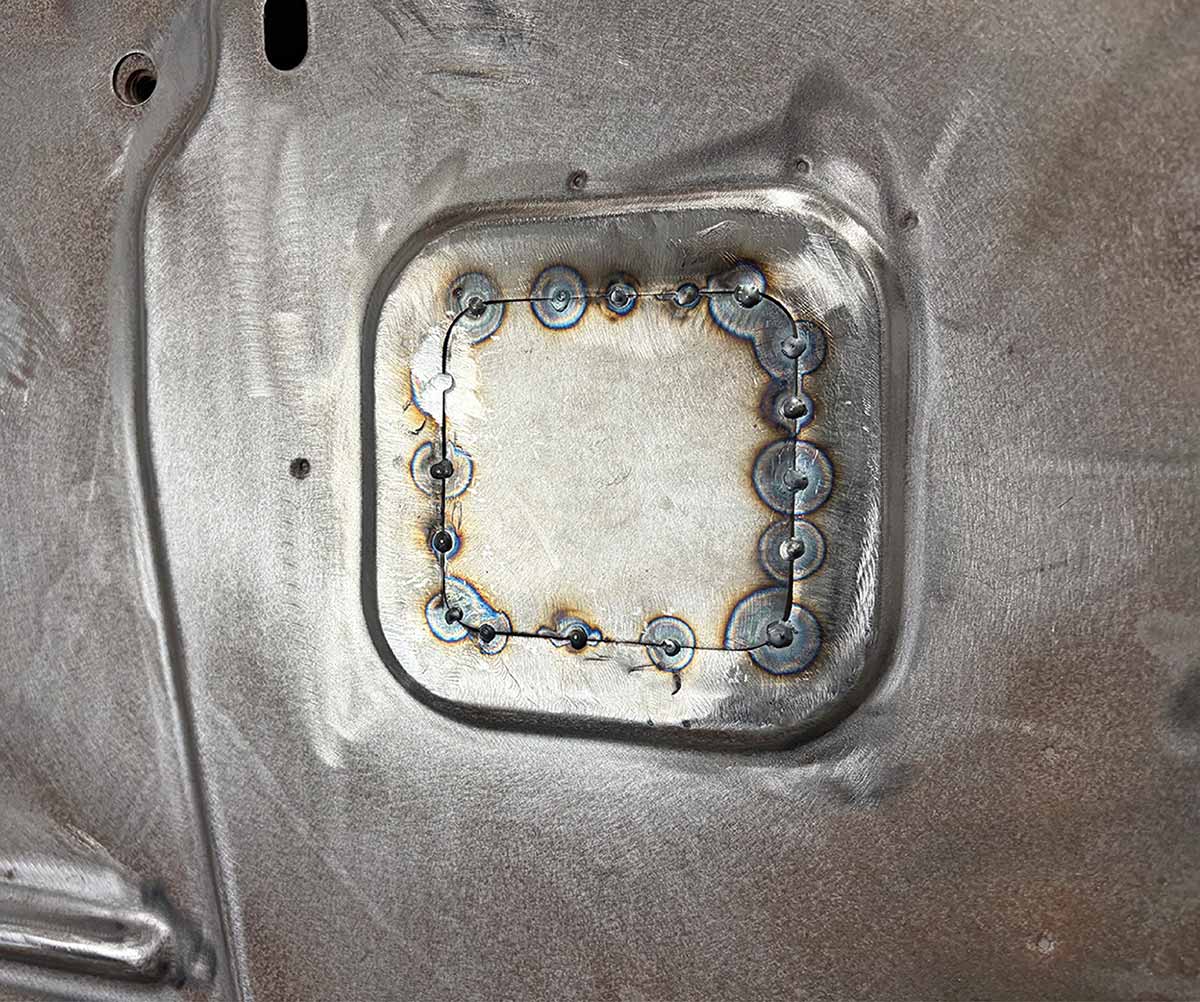
Metal patch tacked into place with welds.
10. The panel is then tacked into place, alternating location to prevent any warpage.
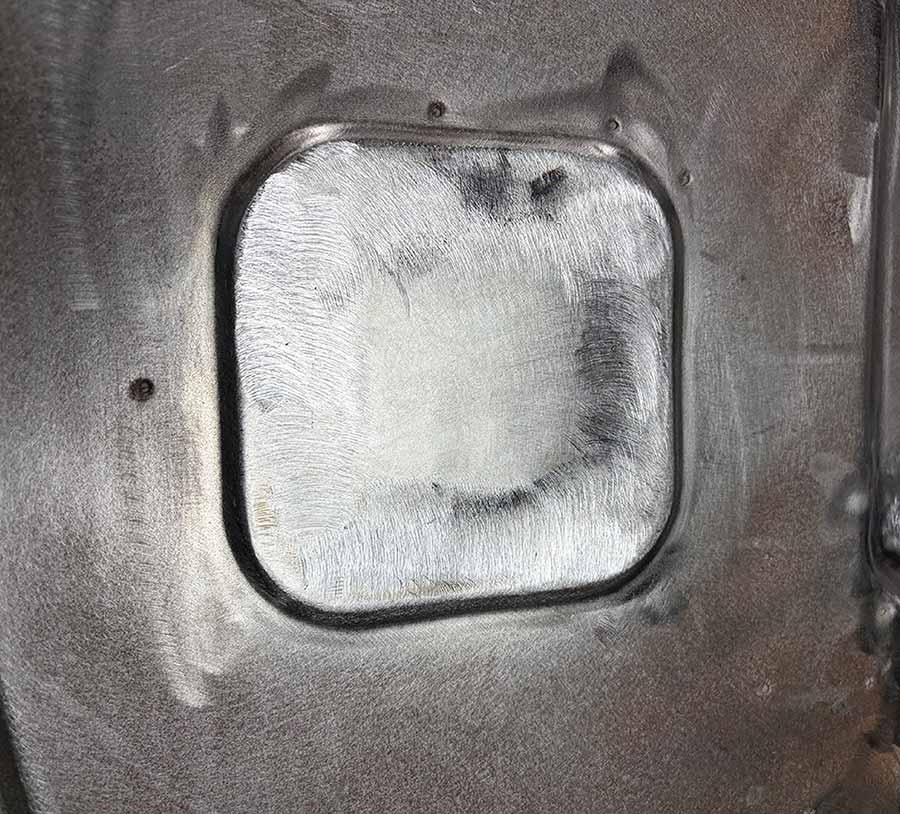
Finished metal patch blended into the firewall.
11. The final patch is metal finished and ready for a little filler and blocking.
Pouring degreaser cleaner into a mixing cup.
12. The first step in the KBS Stop Rust process is to scrub the entire surface using KBS Klean degreaser, diluted approximately 10:1 with hot water.
Spraying cleaner onto the truck firewall.
Scrubbing the firewall with a scouring pad.
13-14. Applied via sprayer, a liberal amount of the KBS Klean dilution is applied to the entire surface and scrubbed with a scouring pad to ensure every nook and cranny of the sheet metal is penetrated.
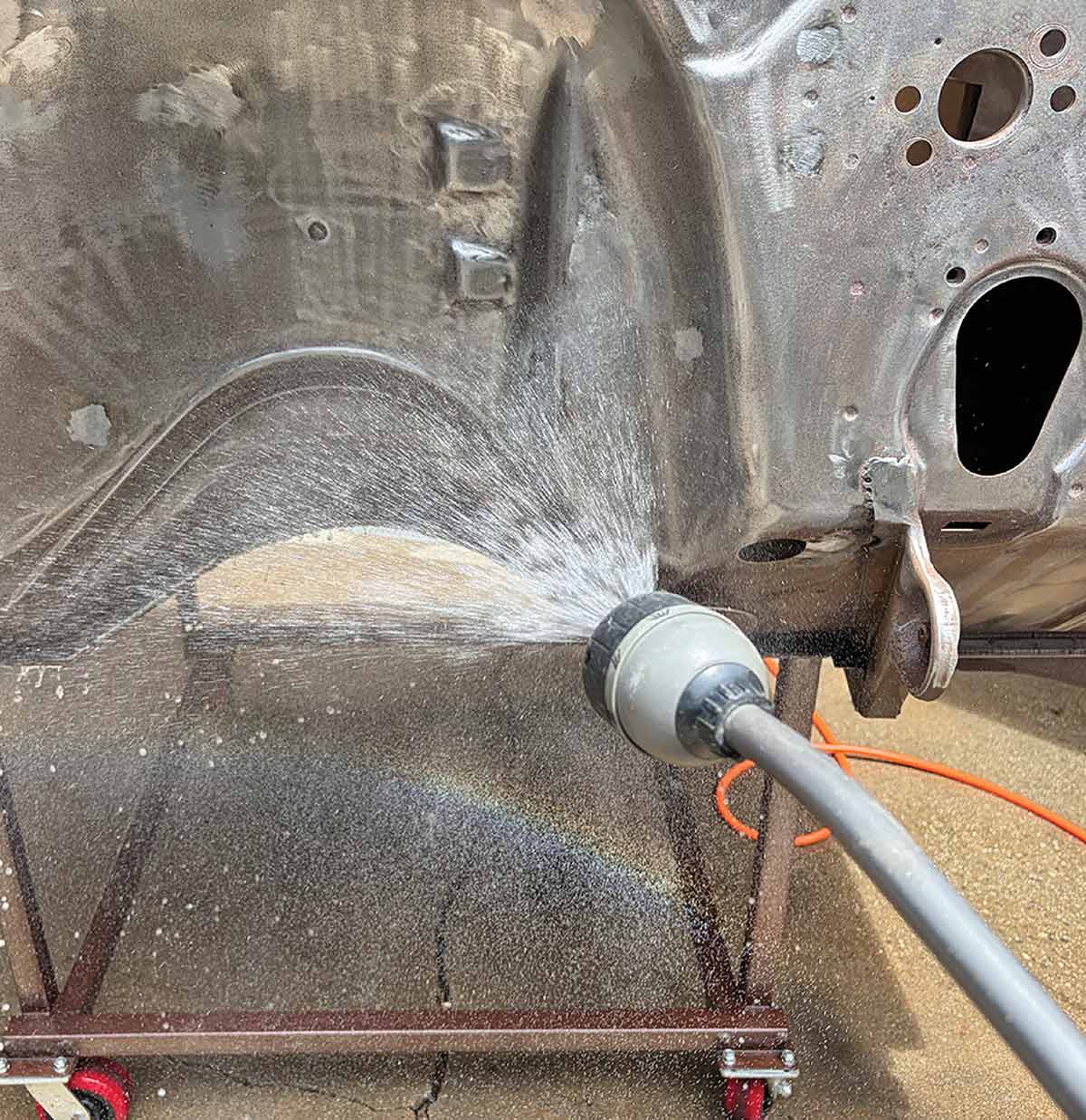
Rinsing the firewall with a water hose.
15. The surface is then fully rinsed…
Drying the metal surface with a cloth.
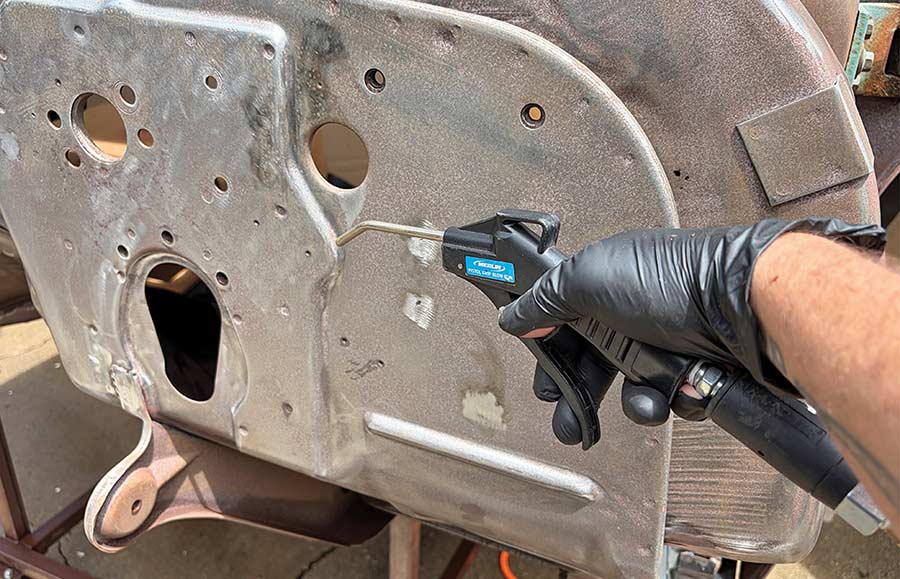
Blowing air into crevices to dry the firewall.
16-17. …and thoroughly dried.
Pouring rust treatment into a spray bottle.
18. With the surface clean and dry, it’s time to treat and passivate the rust that might remain with KBS RustBlast.
Spraying rust treatment onto the metal surface.
19. Applied with a spray bottle, the entire surface of the firewall is treated and kept saturated for a duration of about 15 minutes, due to the fairly light state of rust we’re tackling. For heavier rust, additional soakage time can aid in removal/treatment.
Cleaned firewall after rinsing and drying rust treatment.
20. After another round of comprehensive rinsing and drying, the firewall is looking a lot better than when we started. The zinc phosphate treatment provided by the RustBlast process is evident and what little surface rust that still remains will be further incapacitated.
Can of ceramic rust preventative coating.
21. KBS RustSeal is a single-component, ceramic-like coating that prevents rust and seals metal surfaces, effectively blocking moisture and oxygen intrusion. Before applied, the contents are stirred, ensuring any settled pigments or matting agents are fully mixed.
Taped off cab side before applying coating.
22. Since we’re only tackling the firewall of the cab this round, the surrounding sheet metal is taped off.
Brushing black coating onto a chassis component.
23. Applying KBS RustSeal can be achieved by a number of methods, including spraying, rolling, or brushing. Since we’ll be top coating and further bodyworking the firewall, we’re not concerned with a perfect finish with this step, so we opted to brush the finish to ensure full coverage without dealing with overspray and venting issues. RustSeal is not intended for use as a topcoat where the surface might be exposed to repeated UV, so we’ll be covering it in KBS MAXX at a future date.
Completed black coating on the C10 firewall.
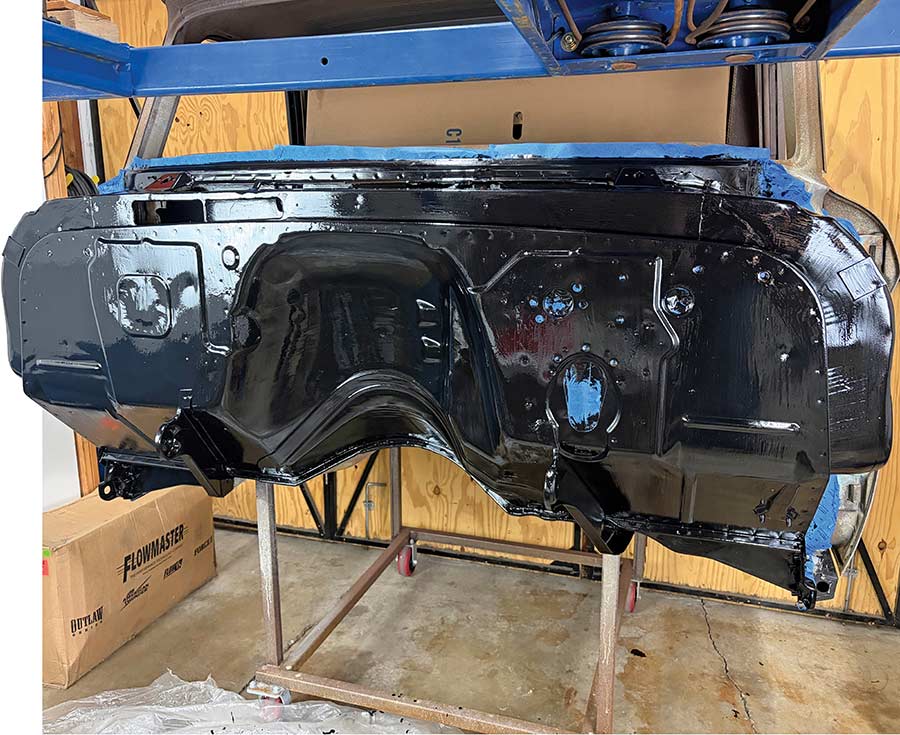
24. The result of the KBS Stop Rust process is pretty impressive thanks to RustSeal’s formulation that allows it flow out to a smooth, flexible finish, regardless of application.
In The Garage Media
KBS Coatings logo

(888) 531-4527
kbs-coatings.com