

CTP Tech
InTheGarageMedia.com
Long Story Shortbed
Preparing an Aftermarket Bed for Paint
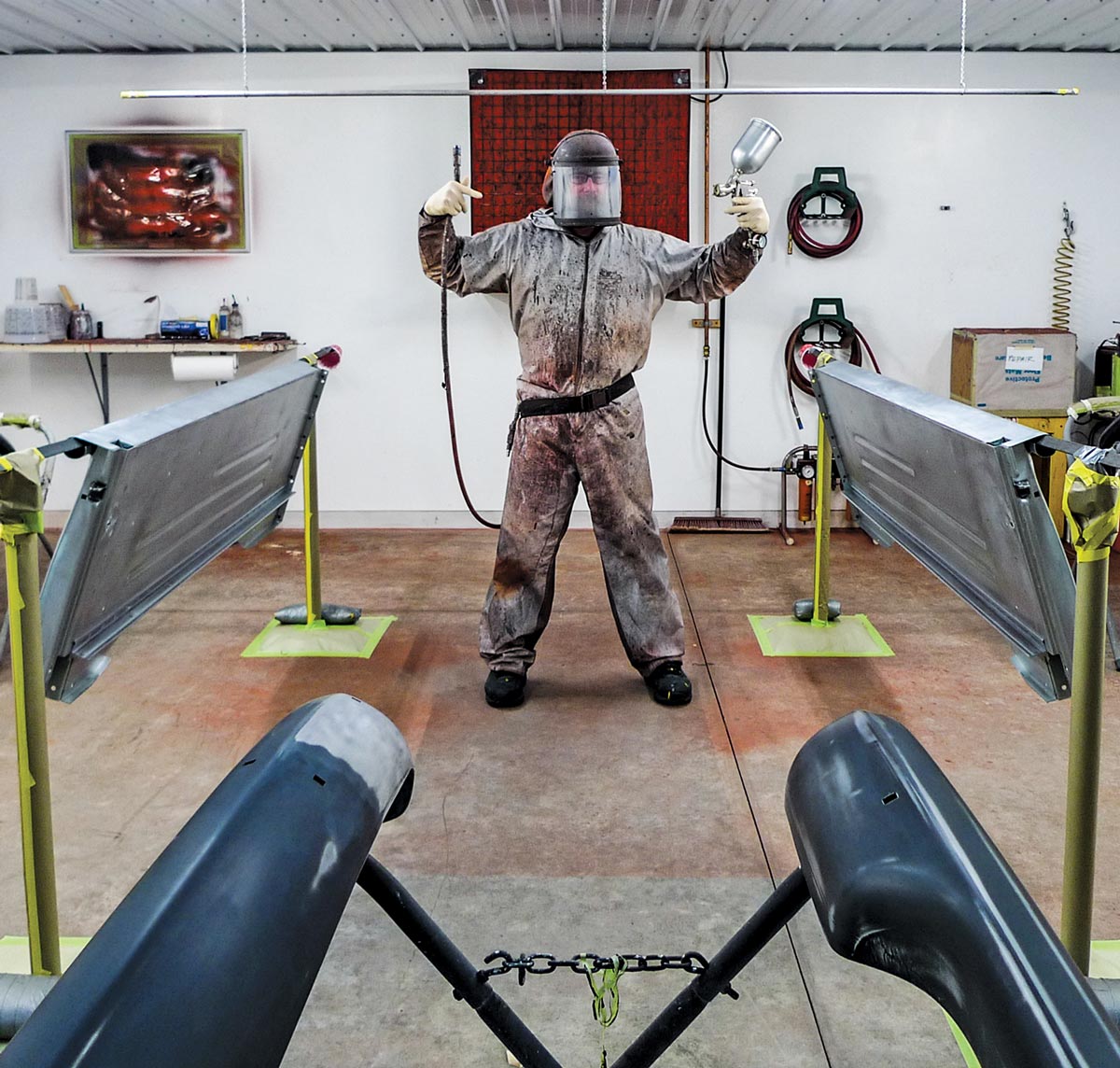
Man in a dirty protective paint suit and face shield stands in a spray booth holding a paint gun and air hose, surrounded by truck bed panels on stands being prepped for painting.
By “Rotten” Rodney BaumanImages By THE AUTHOR
I

n anybody’s paint shop, being the painter comes with its pressures. Here in our own shop, for example, our subject 1955 Chevy second-series project’s finish had better look good—and it had better endure the elements well.

Assuming you’ve been with us, you know that we’re taking advantage of available aftermarket sheetmetal. It’s nice to have the option. In this instance it’s quite necessary, but as the painter here, I must wonder if faraway factory workers truly give a hoot about the work that I must do. Perhaps they do, but since I can’t be absolutely sure, I’m somewhat reluctant to trust whatever coating a brand-new panel might arrive with.

As we’ve understood, reproduction panel manufacturers sometimes use a black “paintable” Electro-Deposit primer coating, or “E-coat” as it’s commonly called. The familiar black E-coat can be prepped and recoated at the painter’s own discretion. Some painters work with it, while others strip it away for a fresher start and proper peace of mind.

During the course of our ongoing build we’ve used a number of black E-coated body parts. Our left door, however, came with a questionable silver coating. It failed the solvent test. Oddly, the wimpy silver stuff had a black coating beneath it, but we opted to strip that door to bare steel.

Currently, with the little truck’s cab, doors, and frontal sheetmetal painted, cut, and buffed, it’s finally time to address a brand-new short Stepside bed. Yes indeed, it’s all the same stuff that I went and picked up a while or two back from Premier Street Rod.

Having now been dry-fit assembled once already, the bed is back in pieces for paintwork. Coming up, we’ll attempt to illustrate a dramatically different procedure. This won’t be anything like the new panel prep methods we’ve previously touched upon.

The new bed panels are galvanized with zinc plating. Also, from the stamping process there’s oily residue left behind, which won’t be easily rinsed, scrubbed, or scoured from within crooks and nannies—particularly those of the bedsides’ stake pockets.

Since this’ll be my own first time working with a brand-new galvanized pickup bed in pieces, I’d kind of like to confer with an expert on the subject. In the paint department of Premier, Isaac Wilde works with these types of bed panels routinely, so, we’ll confer from time to time as we go.

Also, as we go, we won’t try to make any of this look easy. Whether we like it or not, a new bed’s paintwork begins as pure drudgery. For best results, expect to use chemical cleaners repeatedly before switching to household cleaning products, and steaming-hot water to rinse away the oil.

Right about now it’d sure be nice if I hadn’t parked our big steam cleaner in an enclosed car trailer for winter storage. Come to find out, there’s always water remaining inside the pump. Sure enough, when that water froze, it wrecked the pump, and oh my goodness, a replacement pump is spendy!

So, where we happen to be, we get a few painter-friendly months per year. At the time of this typewriting it’s springtime, and there’s no time for downtime. To keep our priority job moving along, our big steam cleaner’s repairs must wait, but we’ll still need steaming-hot water. Our shop’s water heater is a real hot rod. A garden hose could be connected at the washing machine. What if we try hot water through our little cold water pressure washer? We’ve read the entire operator’s manual, and nowhere in there does it say we shouldn’t.

As a disclaimer, we’re not exactly suggesting that anyone should try this at home. So far, we don’t know what hot water will do to our own little cold water pressure washer. We do know, however, that oily residue removal is imperative for good results in the paint shop. In this instance grease ’n’ wax remover isn’t enough on its own. For the soapy steps, steaming-hot water at a fair pressure is a must, even if our little cold water pressure washer must croak for the cause.

Initial cleanup of our new bed panels will begin with solvent-borne grease ’n’ wax remover. Before that evaporates, we’ll wipe the panels dry with clean disposable toweling and repeat as necessary.

Next, for the outdoor steam-cleaning marathon I’ll have my hands full enough without moving a tripod around, and really, I’d rather not spatter a perfectly good camera with hot, soapy water. To illustrate that bit of action I could draw stick figures later, or perhaps I’ll ask Mrs. Rotten to snap phone photos from a safe distance away.

While outdoors, we’ll have two go-rounds with scuff pads, scouring powder, and lots of steaming-hot water. Then we plan to repeat those steps (also twice) with leading-brand dish detergent, which, by the way, does not contain animal-derived ingredients.

When the new panels do eventually make it to the body stall, they’ll be set up at a comfortable working height where they’ll be cleaned with solvent-borne grease ’n’ wax remover and clean disposable toweling—again, before tedious sanding and minor bodywork begin. In this instance, overkill is good, and it sure beats fisheyes later in the booth.

So, on that note, shall we get on with the step-by-step stuff? Along the way we’ll cover proper sanding for clean, galvanized panels, materials to some degree, and the order in which these steps should be taken.

Gloved hands inspect a new, unpainted metal truck bed panel inside its shipping box, revealing small manufacturing creases near the upper stake pocket.
1. Still in their boxes, we can tell they’re beautiful. Near the upper stake pockets we find small, uniform creases. We’ll iron them out with a little bit of filler once the new panels are thoroughly cleaned and sanded.
Assortment of prep supplies on a work stand, including a pump sprayer, box of disposable towels, can of Comet cleanser, stack of green scuff pads, box of gloves, and a long-handled scrub brush.
2. Here’s a look at solvent-borne grease ’n’ wax remover, disposable toweling, household cleaning products, green scuff pads for initial scouring, and so on. It’d sure be nice to use the big steam cleaner … but we’ve already talked about that.
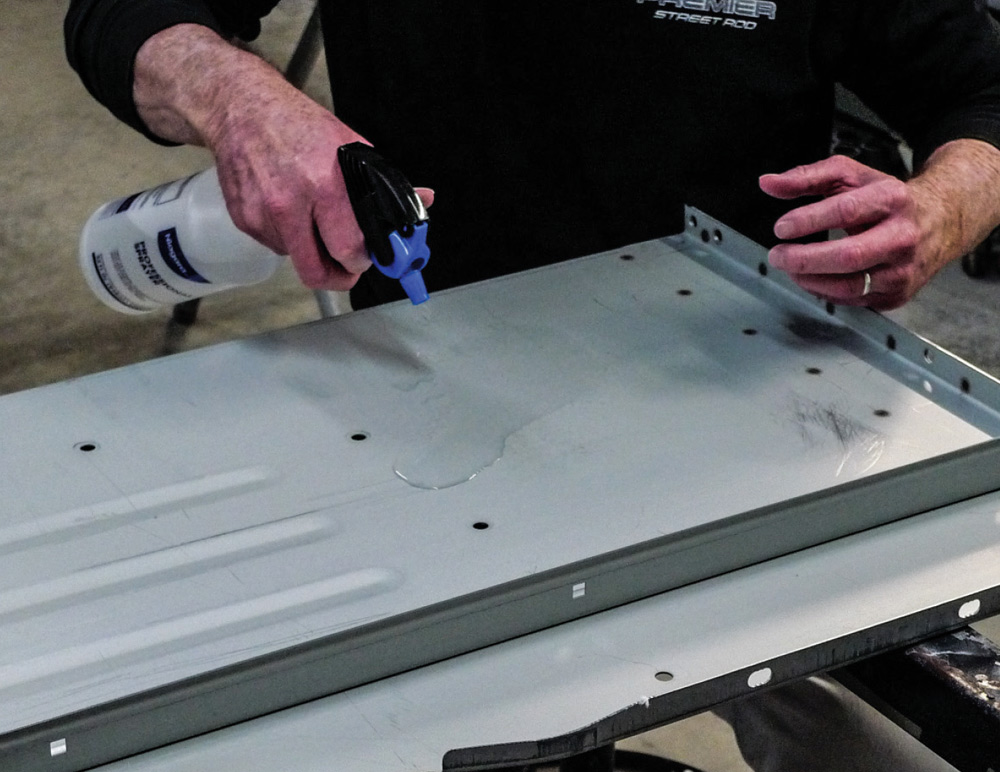
Technician sprays solvent-borne grease remover onto a gray metal truck bed panel using a pump sprayer, holding a white towel ready to immediately wipe the surface dry.
3. First things first, let’s get after the oily residue with solvent-borne grease ’n’ wax remover. Before it evaporates, we’ll wipe it dry. When we’re done, we’ll do it again.
Gloved hands insert a custom cleaning tool, consisting of a brush taped to a long rod, into a truck bed panel's stake pocket to scrub hard-to-reach internal oily residues.
4. For tough-to-reach crooks and nannies, like stake pockets, we’ve fashioned a specific-purpose tool. It’s oily in there, too, so this’ll continue on and on, as well.
Gloved hands hold up a white disposable towel stained with dark gray oily residue, revealing contaminants lifted from the gray stamped truck tailgate in the background.
5. This is our second lap with solvent-borne grease ’n’ wax remover. Here on clean disposable toweling we still see oily residue. With lunches packed, let’s take it outside.
Technician rinses a scoured metal truck bed panel outdoors using a pressure washer spray wand, standing on gravel next to an orange pressure washer unit and a corrugated metal building.
6. One lap into our outdoor degreasing marathon, the panels are scoured down with scouring powder. For the rinse cycle, however, our hot water could be hotter.
Close-up of hands holding a red infrared thermometer displaying 53.9 degrees, checking the water temperature to verify the heat retention of the insulated hose.
7. As hot water travels across concrete, it’s cooling down. So, we’ve jacketed our hose with pipe insulation. For the second lap this made quite a difference, and our expendable pressure washer survived!
Technician sprays water onto a gray metal truck bed panel to test for cleanliness. The water sheets on the surface instead of beading up, confirming that all grease and wax residue has been successfully removed.
8. Dried off and blown out, the new panels are back in the body stall, and they’ve been cleaned again with solvent-borne grease ’n’ wax remover. Now with ordinary H2O, this is the test. If it beads up anywhere, we’ll repeat the previous steps. So far, so good.
An older man wearing a respirator and gloves uses a pneumatic DA sander to scuff a large, flat, zinc-plated metal truck bed panel in a workshop.
9. Trying not to sand through the zinc plating, we begin with the flatter expanses. Here a 6-inch DA (dual-action) sander gets its part of the job done. We’re using 120-grit abrasives, but 150 or 180 would work just fine, as well.
Gloved hands use a small pneumatic detail sander to scuff the tight inside corner of a zinc-plated metal panel where a larger sander cannot reach.
10. Eons ago, when I first saw this type of detail sander at a big trade show, I knew I had to have one. I didn’t know how rarely I’d actually use it, but here it’s real handy in corners where the DA couldn’t reach.
A close-up of gloved hands using a small detail sander to scuff the recessed areas inside the embossed "CHEVROLET" letters on a metal tailgate.
11. The same detail sander is also the hot tip for the tailgate—at least in the tough-to-reach corners of its characters.
Gloved hands carefully finger sand the edges of the embossed "CHEVROLET" lettering on a metal tailgate using a small scuff pad.
12. There’s still a good amount of finger sanding required here, at least for proper peace of mind. Around the edges, everywhere, a red scuff pad comes into play.
A handheld spot blaster tool is pressed against the corner stitch welds of a metal panel to clean irregularities using 80-grit glass beads.
13. With 80-grit glass beads our handy little spot blaster cleans out stitch weld irregularities. It’d do a fine job on spot welds, too, but with so many spot welds, it could get messy.
Close-up of hands using a pneumatic grinder with a spinning wire brush tip to clean spot welds on a corrugated metal truck panel, creating surface texture for primer adhesion.
14. As a tidier alternative, a spinning wire-type implement works well for spot welds. This one’s got the right shape, and it’s stiff enough to leave a little tooth for primer adhesion.
Gloved hands use folded sandpaper to manually scuff the flat surfaces and stamped ribs of a silver metal truck bed panel to prep areas that power tools cannot reach.
15. For the areas machinery won’t reach, we end up sanding by hand. From here we’ll roll all four panels over on their fixtures and repeat the entire procedure.
A gloved hand mixes gray body filler with blue hardener on a board using a yellow spreader. An open can of Evercoat Z-Grip Filler and cans of Rage Extreme sit on the workbench behind the mixing area.
16. Once the new bed panels are thoroughly sanded, it’s filler time, but only for the small creases we pointed out earlier in photo number 1. Here we use different fillers for different purposes. Over zinc plating, Z-Grip fits the bill.
Gloved hands use a yellow spreader to smooth light green Z-Grip body filler over a welded seam on a silver metal truck panel, with yellow masking tape protecting the adjacent edge.
17. When it comes to body shop staples, we pretty much get what we pay for. From our local parts purveyor, Z-Grip isn’t cheap. We generally purchase ours from Summit Racing.
Gloved hands use a flexible dark gray Motor Guard sanding block to smooth a layer of light gray body filler applied to the edge of a silver metal truck panel.
18. Also from Summit, this little Motor Guard sanding block has curled with use over time, which is helpful right here. Switching to finer grits as we go, we’re finishing with 120.
A technician sprays solvent-borne grease and wax remover from a handheld pump bottle onto a hanging silver metal truck bed panel while holding a white cloth to wipe the surface clean.
19. Now we have sanded panels in their primetime positions. We haven’t touched them with bare hands, but here we go again with solvent-borne grease ’n’ wax remover.
Gloved hands hold up two white cleaning cloths covered in heavy black residue in front of a hanging silver Chevrolet tailgate, displaying the zinc and contaminants removed during the cleaning process.
20. This time the black stuff isn’t oil. If we’d sanded bare steel we might assume it’s just carbon, but chances are, this is zinc. At any rate, we’ll do this at least once more.
Hands hold a magnifying glass against a truck bedside coated in black epoxy primer, revealing a smooth, high-quality surface finish on the ribbed metal panel.
21. By this time we’ve applied two coats of black epoxy primer, which hides nothing. These bedsides are nice! We won’t, but we could almost skip straight to base color.
Hands hold a magnifying glass over a black Chevrolet tailgate coated in epoxy primer. The close inspection reveals a smooth, defect-free surface with no fisheyes or contamination on the stamped metal letters.
22. We’re looking hard for fisheyes, but no, we’ve won the war on oily contamination. By the way, this tailgate, straight from the box is just as nice as the bedsides.
A spray gun applies urethane primer-surfacer to a masked-off area of a black tailgate, specifically near the stamped "LET" letters. This targeted priming covers spots affected by welding performed on the opposite side of the panel.
23. Yes, we’re squirting some urethane primer-surfacer, but only in two small spots where we’ve done a bit of welding on the opposite side.
Gloved hands peel back brown masking paper from a black panel, revealing a specific vertical strip of grey primer. This primer covers small uniform creases on the edge, readying the area for guidecoating and block sanding.
24. Back in photo 1, the small, uniform creases sure enough turned out to be the only bodywork required. We’ll guidecoat and block those primed areas the usual way.
Two black truck bedsides rest on paint stands in a shop. The expansive panels are coated in black epoxy primer, awaiting final sanding with a gray scuff pad before receiving sealer, base coat, and clear coat.
25. For the new bedsides’ larger expanses, final paint prep won’t be bad. We’ll do some sanding and finish with a gray scuff pad before epoxy sealer, base color, and clear.