


CTP TECH
InTheGarageMedia.com
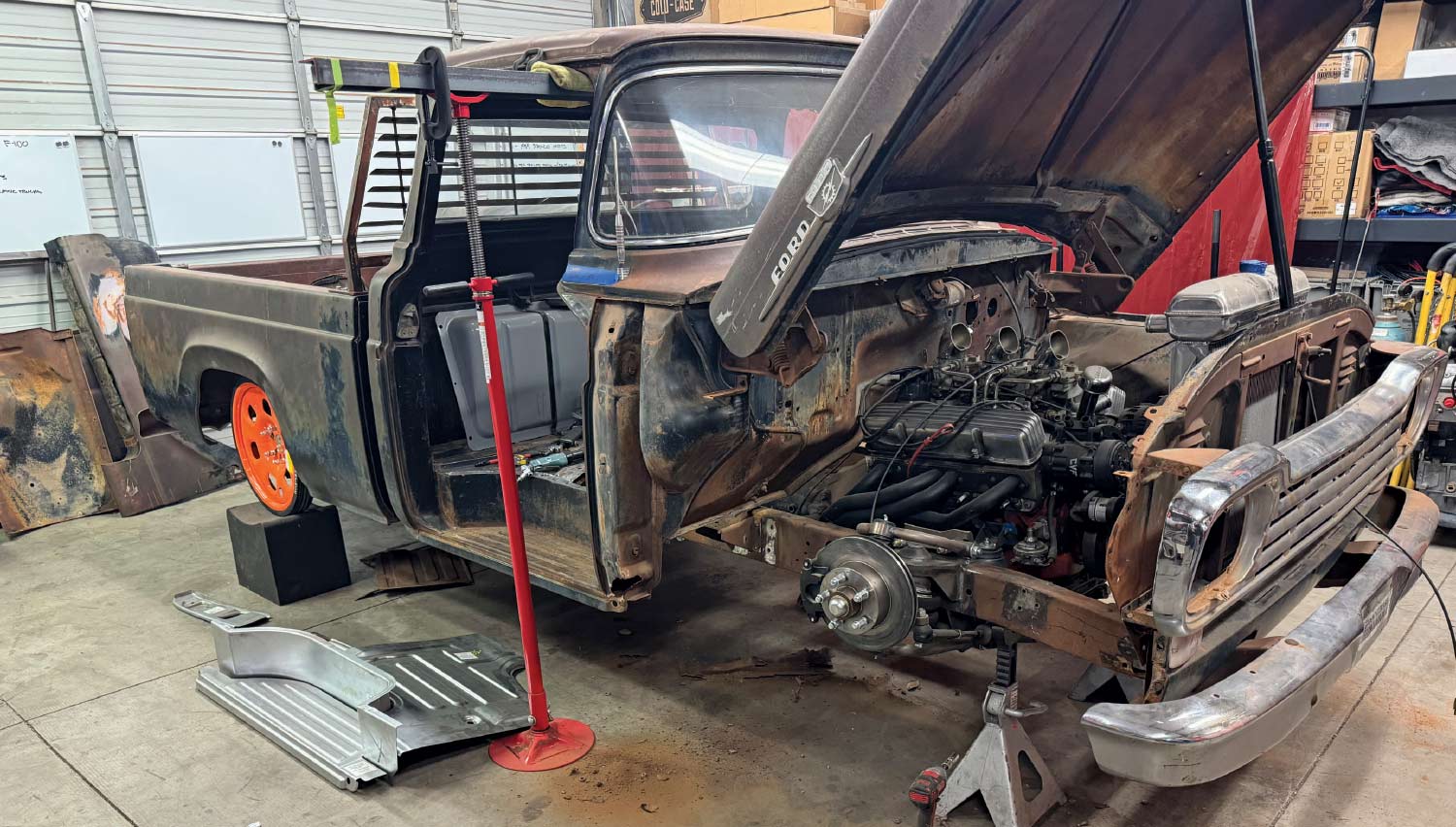
A vintage Ford truck chassis in a workshop undergoing extensive metal restoration with new floor and suspension components visible.
1. Before making any repairs to Sam Castronova’s 1959 F-100, Izzy Pullings supported the cab in the proper relationship to the frame with a pair of tall stands and a steel beam.
Disintegration Dilemma
How to Fix a Rusty Ford
By Ron Ceridono Images Courtesy of Izzy’s Metal Fab
F

or connoisseurs of classic trucks the dirtiest word in the English language is rust. The scourge of all things metal, over time rust can do considerable damage to a vintage vehicle. That damage often leads to a common dilemma: how much rust is too much to fix? For Sam Castronova the decision was easy enough, he wanted this F-100 fixed so he turned to Izzy Pullings of Izzy’s Metal Fab in Phoenix to reverse the ravages of rust.

Castronova’s 1959 F-100 is a third generation F-series truck (the first generation was produced from 1948-52, the second series from 1953-56). Introduced in 1957, the third-gen F-Series was produced through 1960. These trucks were “modernized” with a wider cab and front fenders and hood that blended into the body. For the first time two types of pickup boxes were available, the “Flareside“ with separate fenders, or the smooth “Styleside” bed. While the cabs remained virtually the same during the series production run, there were some styling changes to the front end. The ’57s had dual headlights and a plain hood with its centrally located Ford badge; quad headlights and a new hood appeared in 1958; in 1959 there was another new hood with a front air intake that housed Ford lettering; finally for 1960 there was yet another new hood with slots on both sides of the front edge and a mid-mounted Ford emblem along with a redesigned grille and relocated parking lights.

While Castronova’s truck was admittedly rough, the F-100 did have some redeeming qualities. It was equipped with the desirable “big” back window option, the chassis had been updated with an independent front suspension with four-bars and airbags added in the rear. Under the hood is a small-block Chevy with triple two-barrel carburetors backed by a Turbo 350 automatic transmission. Then there was the truck’s unique history—it had once been an Oklahoma Highway Patrol vehicle of some sort. With all those factors considered, along with Castronova’s appreciation for unusual vehicles, the truck was deemed too cool not to be saved so it was up to Pullings to bring it back from the brink of extinction.

After a quick inspection it was determined that both door posts required repair, the front cab supports would have to be replaced, and a new floor would be needed. While the truck was in need of some major repairs, Pullings isn’t easily discouraged and could visualize its potential. An extremely talented craftsman with decades of experience, Pullings took on the project and replaced the corroded sheetmetal with a combination of custom patches and stamped replacements from EMS Automotive. Known for quality sheetmetal components, EMS offers a variety of replacement pieces for third generation F-100s, all precision stamped in 18-gauge steel and made in Detroit.

As the truck’s front cab supports were completely destroyed, the body shell had to be held up with a pair of tall stands and a beam through the door openings while repairs were made. To repair the two-piece door post on the left side Pullings used an inner replacement panel from EMS that extends from the step plate (the running board inside the cab) to just below the upper hinge pocket. The EMS main door post replacement (the front side of the door post) is also a full-length panel. However, because the decision was made to save as much of the original sheetmetal as possible, Pullings elected to shorten the new panel and only replace the lower portion of the damaged door post. In addition, the step plate (the running board hidden by the door) and the step plate riser (the panel that extends from the step plate to the cab floor) needed repair. Again, Pullings used portions of the EMS replacement panels to fix those damaged parts rather than replace them completely. Fortunately, the rust on the right side wasn’t as severe, with only the main door post requiring repair.

While replacing the damaged sheetmetal was unavoidable, the goal was to make the truck look as though none of the repairs were ever made. To that end Pullings masterfully blended the new sheetmetal with the old even in places it would never be seen. Castronova wanted a safe, reliable driver that looked like just what it is, a cool old survivor truck with a colorful past and that’s just what he got. Dilemma solved.

Close-up of severely rusted and thin metal on a vehicle frame, showing jagged edges and significant corrosion damage.
2. The damage to the floor and door post on the driver side was extensive, but there was more below the surface.
View of a rusted inner rocker panel and floor section of a truck being cut away for restoration.
3. With the floor removed the extent of the damage to the front cab support can be seen, which explains why the cab had to be supported while repairs were made.
Close-up of a truck door pillar where old rusted metal has been cut out to make room for new replacement panels.
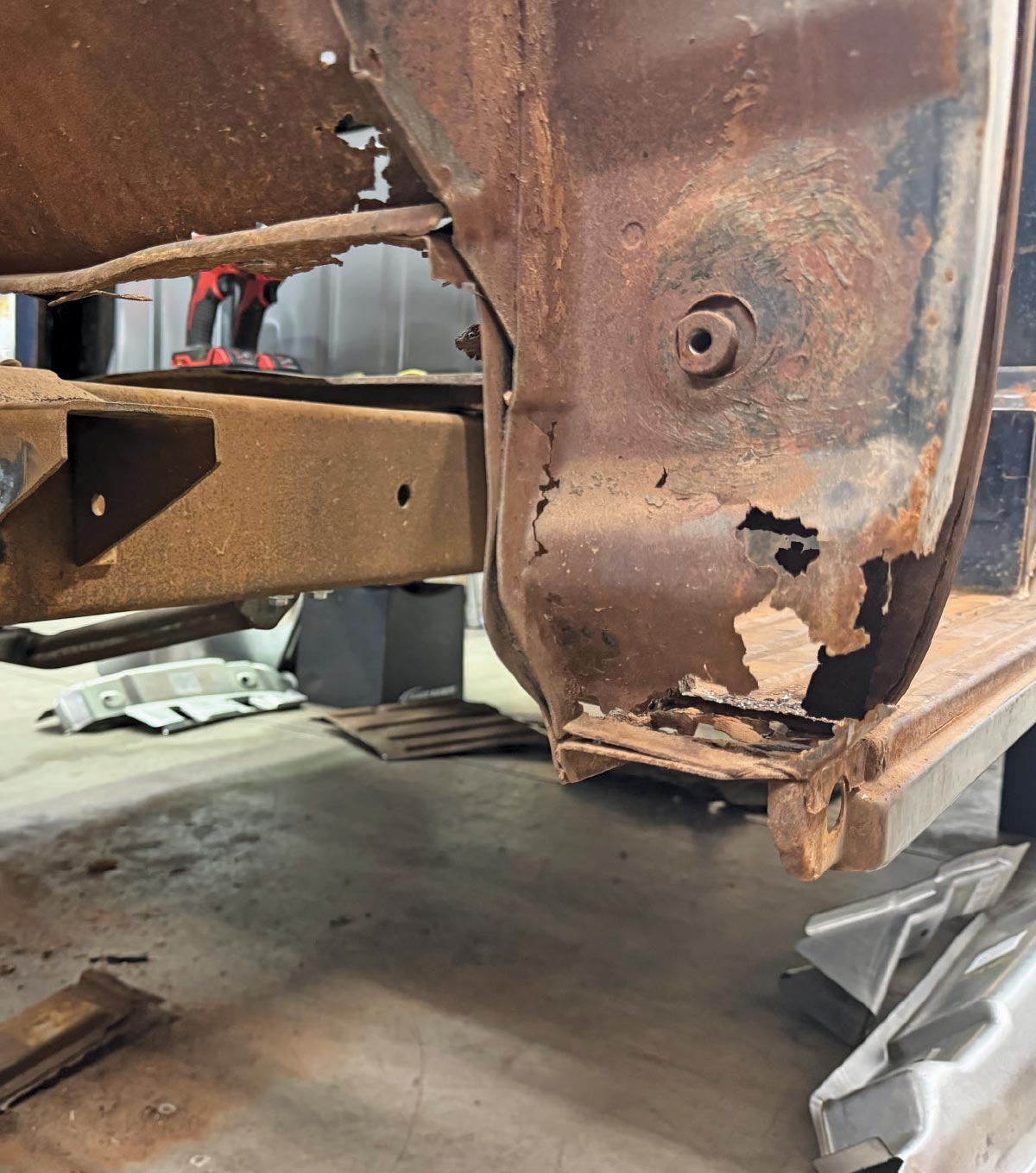
4. The front of the step riser was completely gone. This panel extends from the front to the rear of the door opening.
A severely rusted lower cab corner and floor support section on a vintage truck before being repaired.
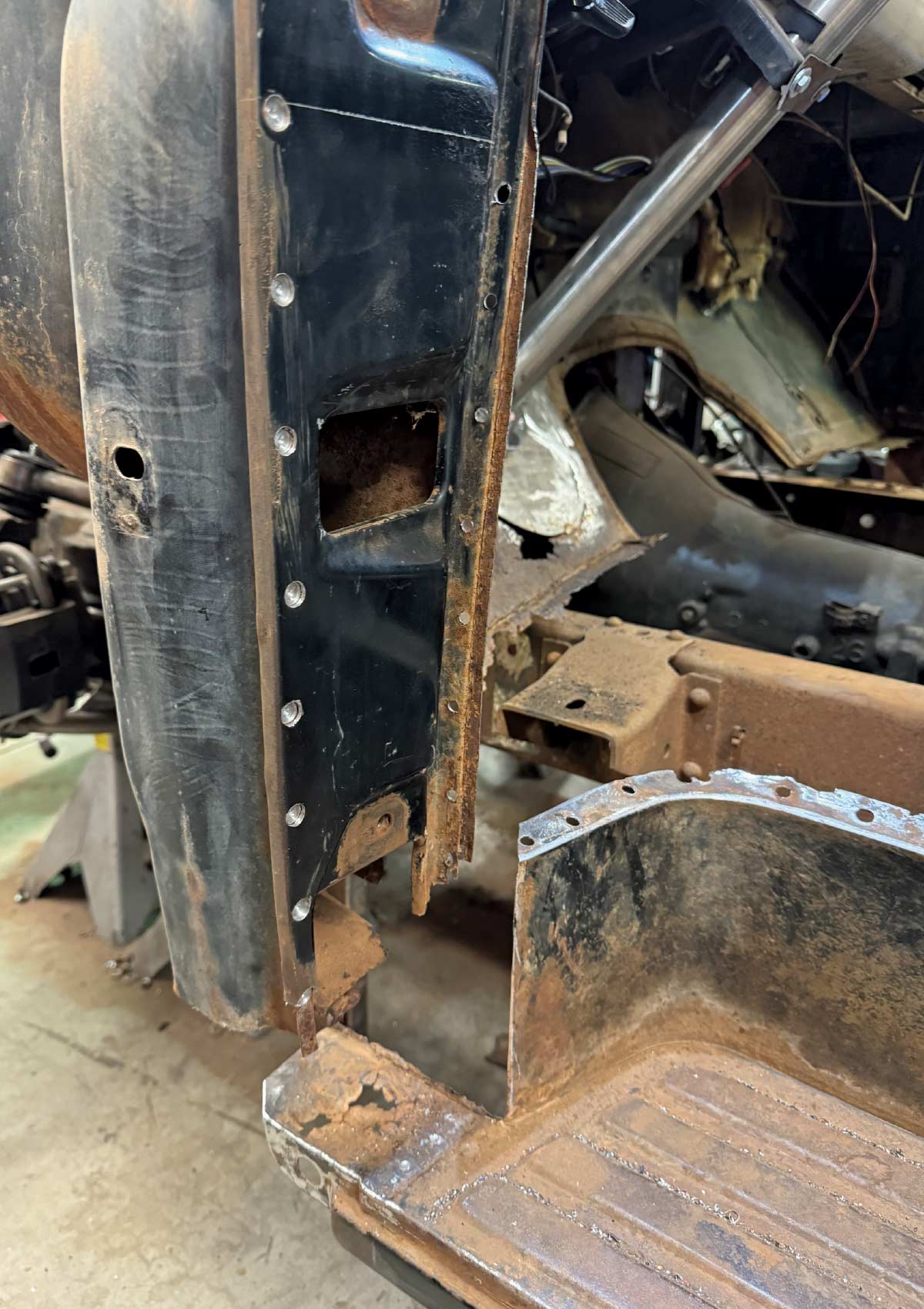
5. Here the damaged portion of the step riser has been cut away and the spot welds in the inner door post have been drilled.
View of a rusted truck floor section with the replacement panel being test-fitted over the frame.
6. The bottom of the main door post on the left side was rotted at the very bottom. This piece is tied into the cowl and the step plate.
A new steel replacement "inside step plate" for a 1957-60 Ford F100 truck held against the rusted original part.
7. After removing the inner door post the rotted portion of the main door post was cut off.
A new inner step plate replacement panel being test-fitted and held in place with magnets on a truck cab.
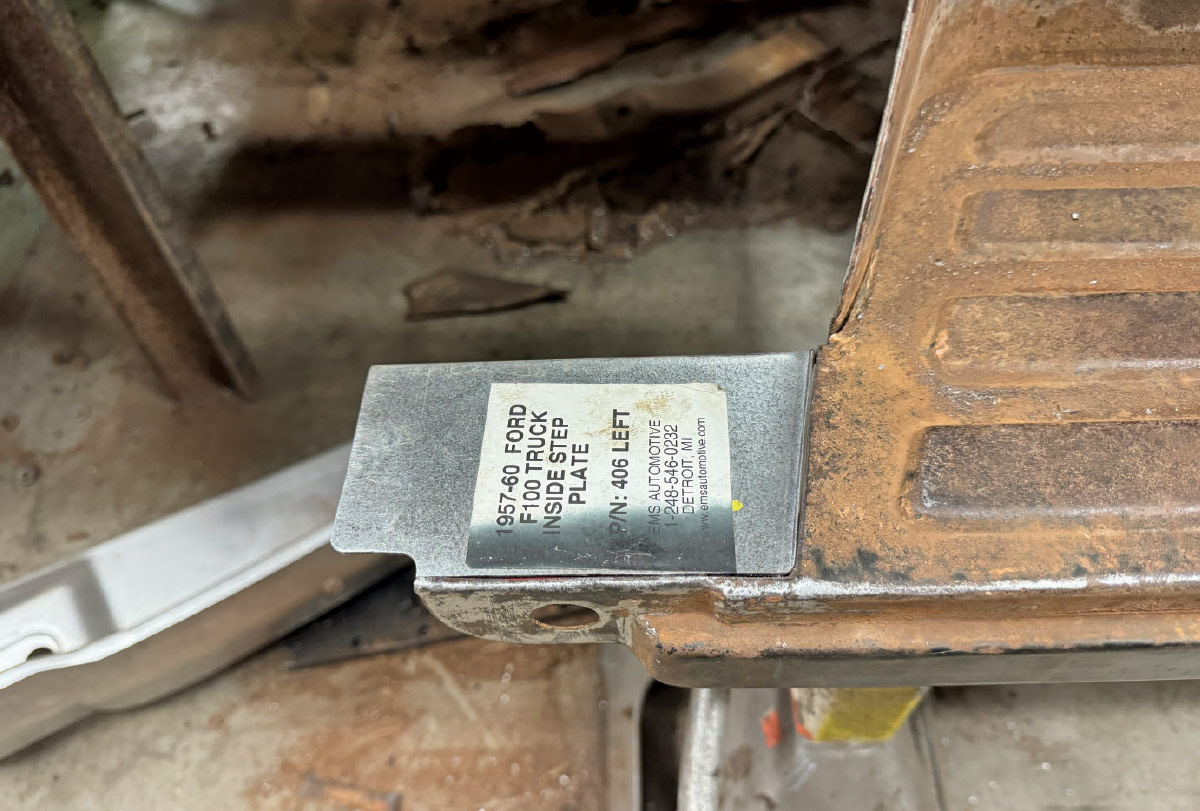
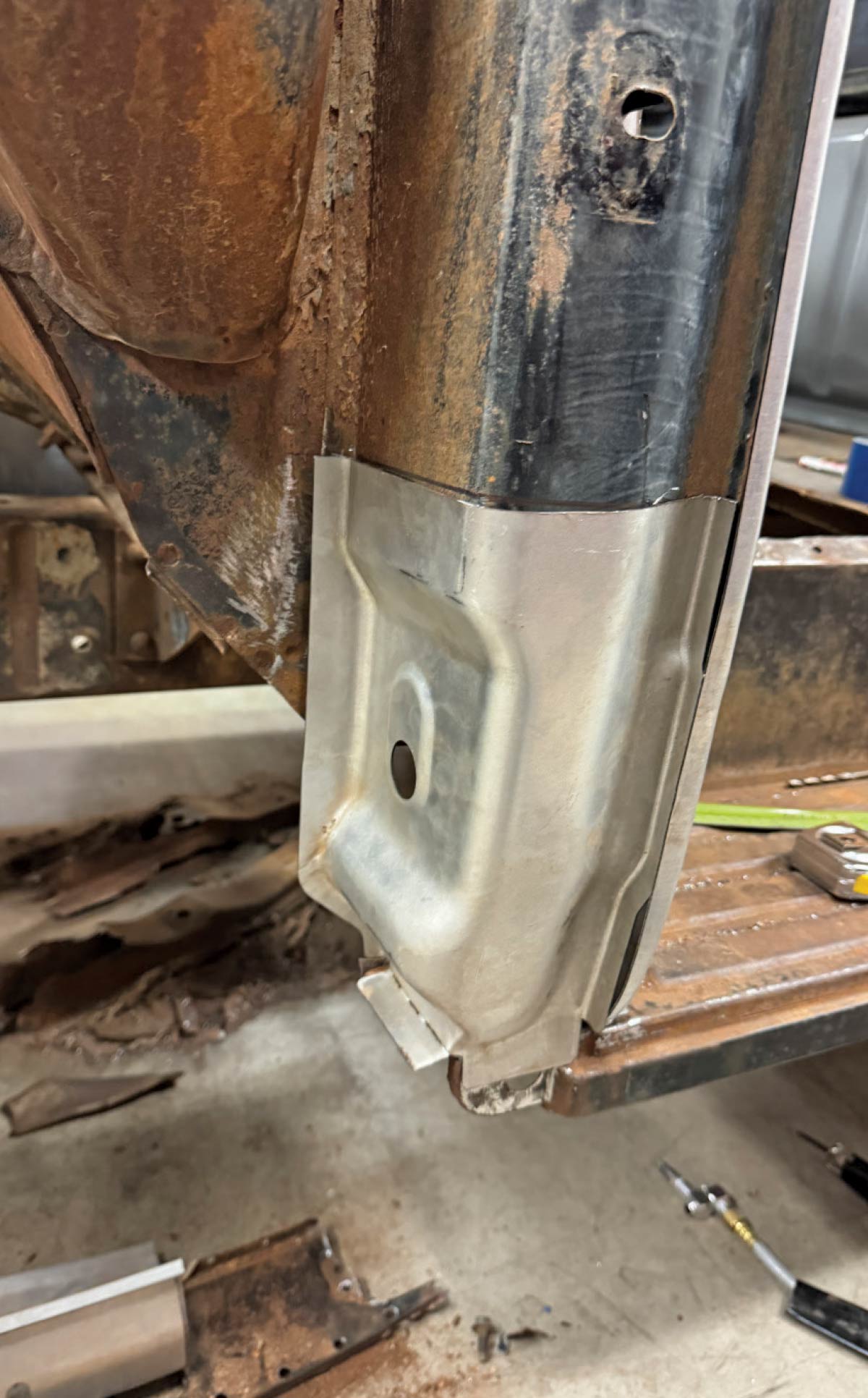
8. In an effort to retain as much of the original sheetmetal as possible, rather than installing an entirely new piece the original step plate was repaired with a portion of the EMS replacement.
Close-up of new fabricated steel interior cab mounts welded into place during a truck restoration.
9. Like the step plate, the step plate riser was repaired with a portion of an EMS replacement panel.
A new "inner door post" replacement panel for a vintage Ford truck being fitted into the restored door pillar.
10. Viewed from the inside, the original lower hinge bracket was put in place. As it was originally, the bracket is spot welded to the main and inner door posts.
A technician uses multiple C-clamps to secure a new steel inner door post replacement panel onto a vintage truck cab for welding.
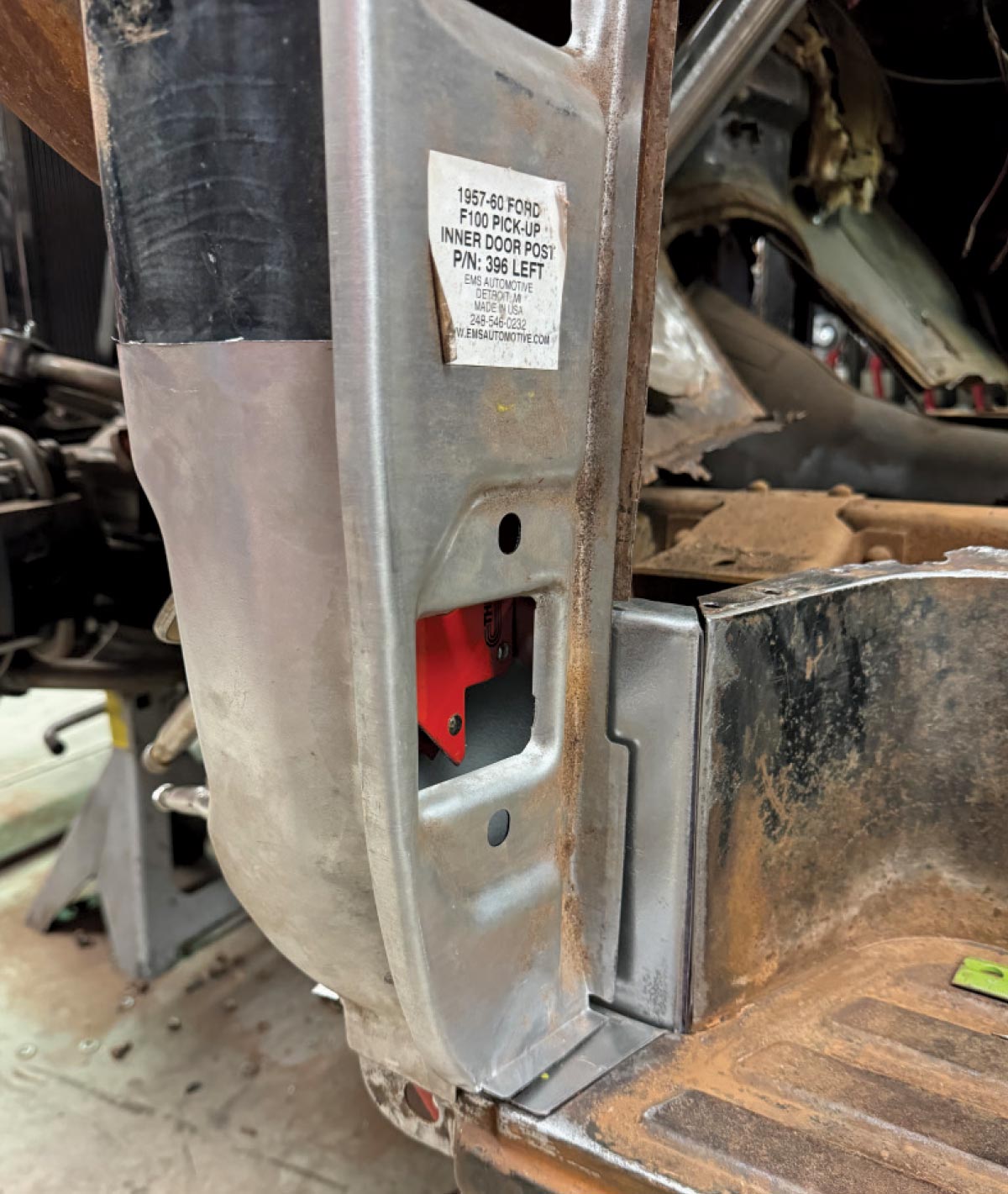
11. A test-fit of the new inner door post shows how it fits with the step plate, the riser, and overlaps the main door post.
Close-up of a new steel inner door post panel precisely aligned and bolted onto a restored truck pillar, with marker lines for final trimming.
12. The new inner door post has an offset that fits behind the upper portion of the original sheetmetal after it’s cut. The gap will be welded and ground smooth.
View of a replacement inner door post panel welded into place, showing clean metal against the older rusted sections of the cab.
13. To hold the replacement pieces in place Pullings prefers sheetmetal screws to Clecos as they pull the panels together for a tighter fit.
A person in work gloves points to the tight gap between a new steel door post and the original rusted truck floor during a fitment check.
14. Spot welds are used to secure the new inner door post to the bottom hinge bracket just as it was done originally.
A new steel "front of cowl" repair panel is test-fitted over a rusted section of a vintage Ford truck cab.
15. Pullings began making plug welds securing the inner post to the step late and riser. Note the alignment marks used to ensure that all the pieces are where they should be.
Multiple locking pliers and C-clamps hold a new front cowl repair panel in place on a truck during the metal restoration process.
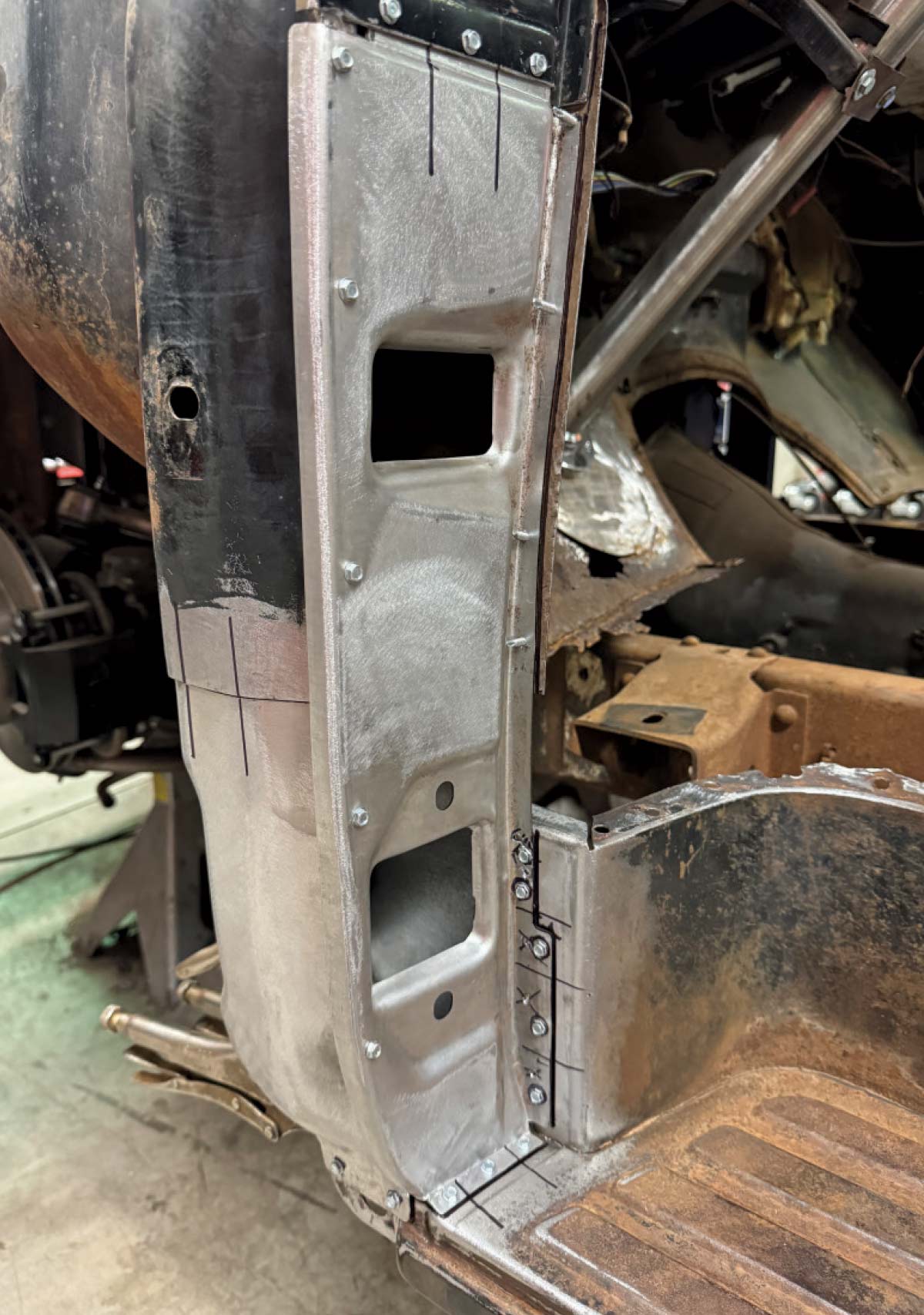
16. After cutting away the damage portion of the left main door post, the full-length replacement was trimmed to fit.
Close-up of a new steel replacement panel seamlessly welded and ground smooth on a truck's front cowl and pillar section.
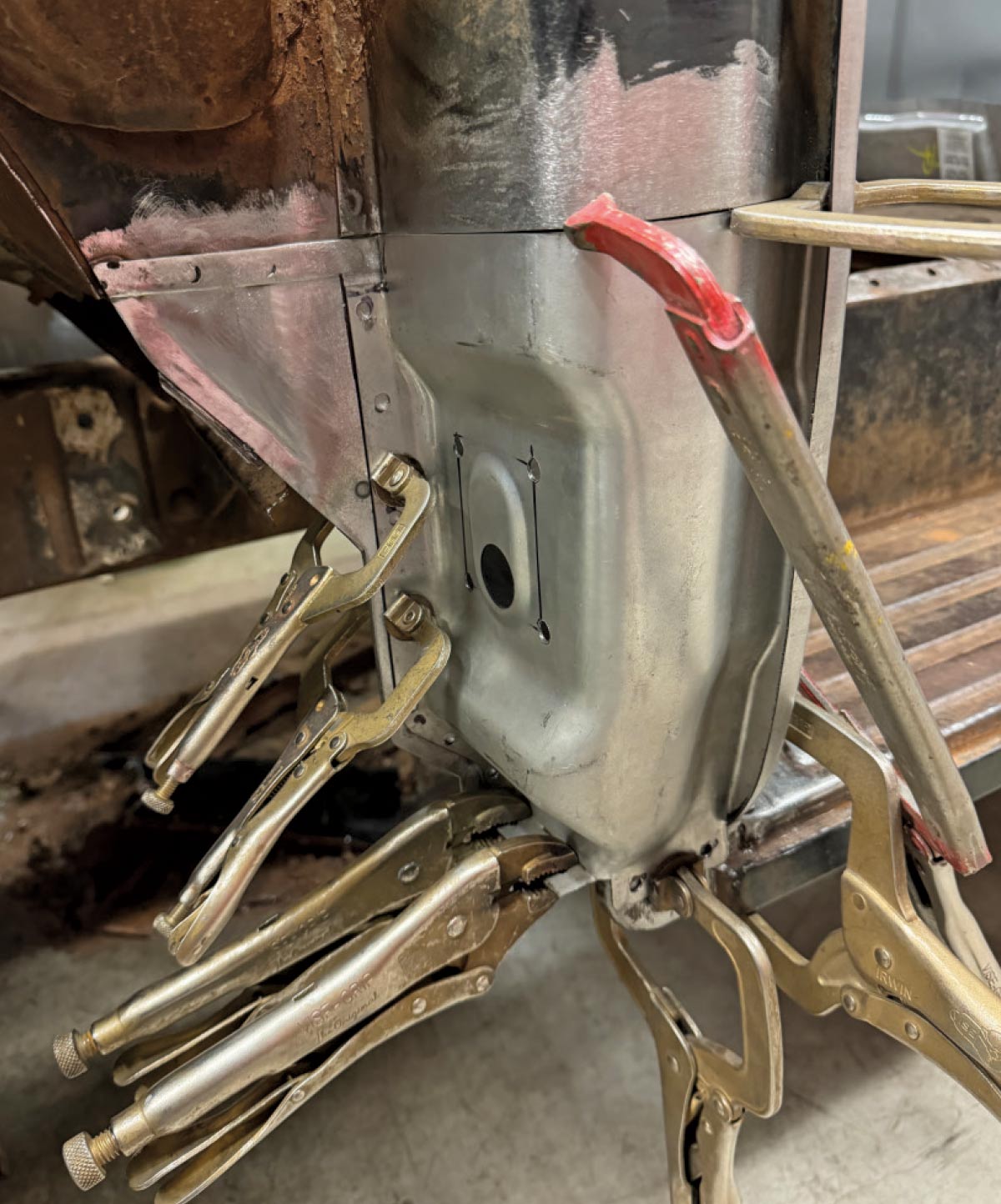
17. With the replacement panel clamped in place, Pullings fabricated the small triangular piece that attaches the door post to the cowl.
Full view of a restored Ford truck door pillar featuring new steel panels integrated into the original rusted body.
18. Here is an example of Pullings’ craftsmanship: the complete repair has been ground smooth, making the welds undetectable.
View under a truck cab showing the original rusted cab mount and frame rail alongside newly cleaned metal sections.
19. After a coat of flat-black paint a major goal was achieved: the door post looks like it was never repaired.
A technician uses a C-clamp and blue tape to secure a new steel repair panel onto a truck cab near the door hinge area.
20. On the right side of the cab the damage to the door posts was less severe. Here the rotted lower portion of the main door post was cut away—the original hinge bracket remained in place.
View of a truck chassis with the engine removed and the original rusted floor sections cut away.
21. Again a full-length EMS replacement panel was trimmed to repair just the damaged area of main door post.
Close-up of a truck's rear floor area where the rusted metal has been ground smooth in preparation for new floor panels.
22. A number of issues were obvious after removing the floor. The toeboards would require repair, the previously patched hole around the steering column would have to be fixed and that missing bolt in the bellhousing will have to be replaced.
New steel replacement floor pans for a 1957-60 Ford truck being test-fitted over the frame rails.
23. A support for the floor runs the width of the cab, the replacement floorpans overlap this piece and are welded to it.
View of the newly installed steel floor pans and transmission tunnel cover inside a vintage Ford truck cab.
24. The EMS replacement floorpans are two-piece, which leaves a gap in the center. This is not normally a problem as the area isn’t prone to rust. However, in this case, it had been notched for some reason, so the section was removed.
Close-up of new steel floor panels precisely fitted and welded around the steering column area.
25. Even though no one will ever see it, Pullings made the floorpan appear to be one piece by fabricating a new centersection and welding all three pieces together.
View of small steel patch panels welded in to bridge gaps between the new floor pans and the original firewall.
26. On the left side the new floorpan was welded to the toeboard where the two meet. The hole below the steering column was patched and ground smooth.
Interior view of the completed metal restoration on a truck floor, finished with a protective black coating.
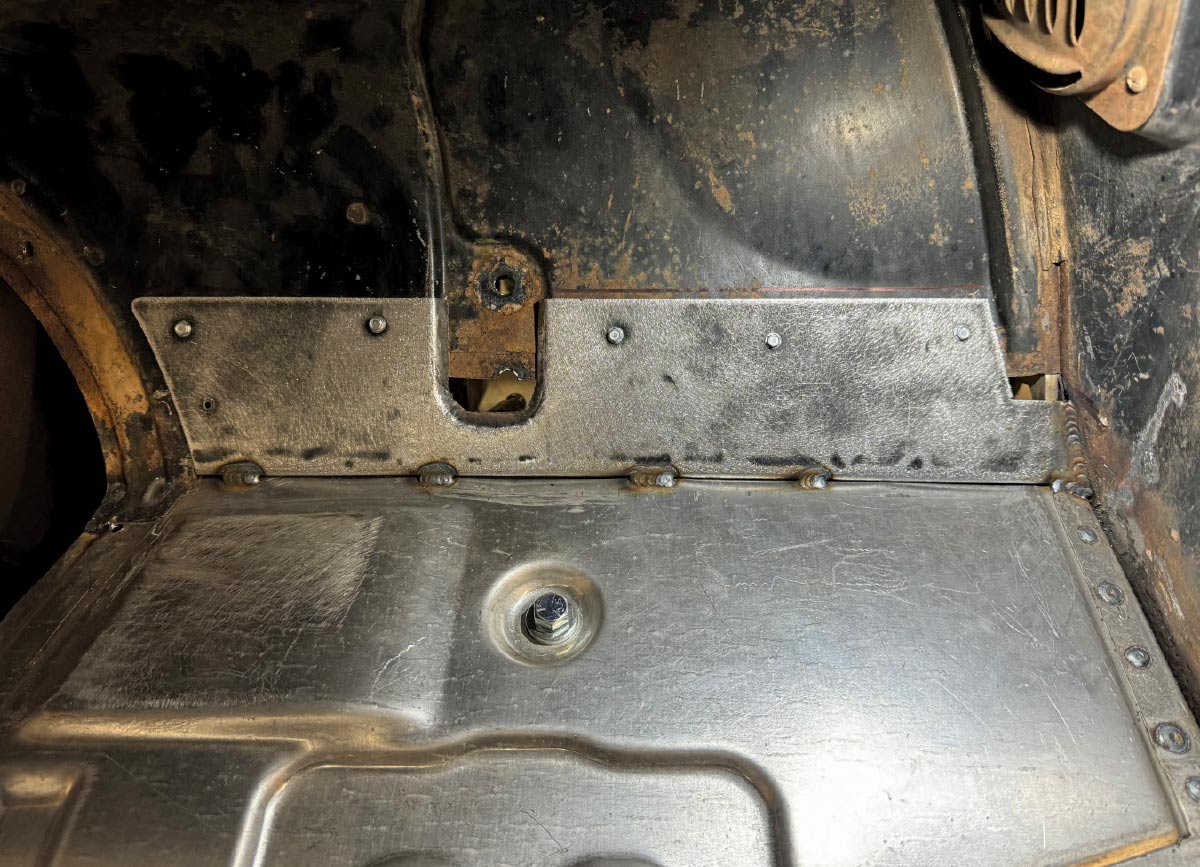
27. On the right side the toeboard required repair so Pullings fabricated a patch. Here it’s screwed in place at the top and tack welded to the floorpan at the bottom to be welded later. Note the plug welds that secure the floorpan to the step panel extension.
Close-up showing severe rust and holes in the original floor support braces under a vintage truck.
28. From below, the damage to the left front cab support is obvious. The support on both sides of the truck were replaced.
View under a truck cab showing new steel floor supports and cab mounts bolted and welded into place.
29. The new cab supports not only make the floor solid they renew the structural integrity of the cab, something that had been lacking for some time.
View of the finished underside of a truck floor, featuring new steel panels and supports with a black textured finish.
30. After welding the cab supports to the floor and cowl they were given a coat of flat-black paint to match the other repairs.